

Close Menu
Pet Business World
  • Trade News
    • Distributors
    • International
    • Legislation
    • Manufacturers
    • Other trades
    • Retailers
  • New Products
    • Birds
    • Cats
    • Dogs
    • Small Animals
  • Features
    • Industry Experts
    • Retailer profiles
  • Aquatics
  • Columnists
    • Newshound
    • Reptile Trade Views
  • People
  • Magazines
    • May 2026
    • April 2026
    • March 2026
    • February 2026
    • January 2026
    • December 2025
  • Classifieds
  • Trade Directory
  • Advertise
  • Email Newsletters
  • Subscribe
Facebook X (Twitter)
  • FREE Email Newsletters
  • About Us
  • Advertise
  • Contact Us
  • Free Magazine Subscriptions
X (Twitter) Facebook
Pet Business World
  • Trade News
    • Distributors
    • International
    • Legislation
    • Manufacturers
    • Other trades
    • Retailers
  • New Products
    • Birds
    • Cats
    • Dogs
    • Small Animals
  • Features
    • Industry Experts
    • Retailer profiles
  • Aquatics
  • Columnists
    • Newshound
    • Reptile Trade Views
  • People
  • Magazines
    1. May 2026
    2. April 2026
    3. March 2026
    4. February 2026
    5. January 2026
    6. December 2025
    7. November 2025
    8. October 2025
    Featured

    PBW News – May 2026

    By David ReesMay 14, 2026
    Recent

    PBW News – May 2026

    May 14, 2026

    PBW News – April 2026

    April 10, 2026

    PBW News – March 2026

    March 10, 2026
  • Classifieds
  • Trade Directory
Pet Business World
Aquatics

Fish might have to trade brains for brawn

Michele SwalesBy Michele SwalesMay 19, 20203 Mins Read
Facebook Twitter LinkedIn Email
Share
Facebook Twitter LinkedIn Email

/

Climate change could leave freshwater fish with bigger brains but a reduced ability to effectively explore their surroundings, scientists have found. 

In order to survive, the world’s aquatic life will need to adapt to the warmer waters that global warming will produce in the coming decades. 

New research by University of Glasgow biologists suggests that the physiological changes fish will undergo in warmer rivers might require them to trade brains for brawn, with potentially challenging consequences. 

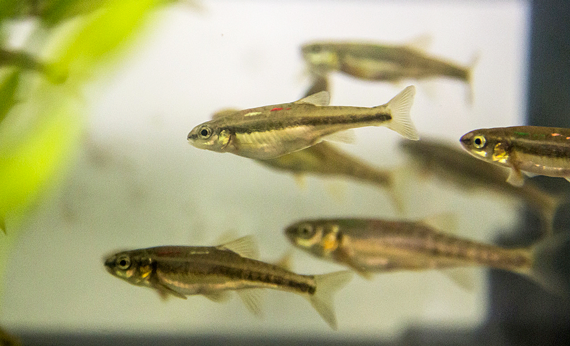
In order to test how living in warmer waters might affect cold-blooded freshwater fish, researchers from the University’s Institute of Biodiversity Animal Health & Comparative Medicine fished minnows from the river Kelvin, close to the university, and split them into two groups. 

One group of minnows was raised in tanks filled with water kept at the river’s usual temperature of 14°C. The other spent their time in tanks heated to 20°C, at the higher end of the temperature range climate scientists expect the river could reach by the end of the 21st century.

BEHAVIOUR

Over the course of eight months, the researchers paid close attention to each minnow’s physiology and behaviour, and watched how they interacted with their environment. 

Measuring the minnows’ oxygen consumption at rest and during exercise showed that the fish in the warmer tanks used more energy in both states, suggesting their metabolisms had ratcheted up as they adapted to the heat. 

The researchers also observed that the minnows from the 20°C tanks developed bigger brains than their cooler counterparts. However, despite their bigger brains, they performed significantly worse in a test designed to measure their ability to navigate and find food.

They struggled to navigate a maze to reach a mealworm and, even though they had four attempts to learn the layout of the puzzle, their performance did not improve with repetition. 

Dr Libor Zavorka, the paper’s lead author, said: “While the minnows we studied were able to adapt to live in the warmer water, their reduced ability to find their way around in order to catch food does raise some questions. Although we found their brains were larger, they seemed less able to accomplish the simple tasks that minnows carry out every day. 

BRAIN

“It’s likely that the expansion of brain tissue isn’t accompanied by an expansion of neural density, so their brains don’t provide any additional benefits for being larger. Brain tissue requires a lot of energy to maintain, so it’s likely that the minnows’ bigger brains act solely as a drain on their resources. 

“As their metabolisms increase to cope with the larger brains and the increased temperature of the water, they will need to eat more to fuel their bodies – but if they are less able to find food efficiently, they will need to spend more energy looking for it.” 

Professor Shaun Killen, head of the research group which produced the study, said: “We chose minnows for this study because they’re a useful model species, found in many places across the northern hemisphere across a broad range of temperatures.

“Surprisingly, this research is the first real study of how fish physiology, brain structure and behaviours might be affected by the warming of their habitats. 

“Our findings suggest that disrupting the delicate balance between the minnows’ physiology and their environment causes some unexpected side-effects. We’re keen to extend our research further to explore the potential outcomes for freshwater fish in the increasingly challenging environments they will face in the future.”


Previous ArticlePlea for shop workers to be treated as ‘public servants’
Next Article Effipro now available to pet shops
Michele Swales

Read Similar Stories

Aquatics

OATA creates sustainable sourcing aid

April 22, 2026
Aquatics

New documentary warns of dangers of “positive lists”

March 9, 2026
Aquatics

New directors join OATA Board

January 20, 2026
Most Read

PBW News – May 2026

May 14, 2026

Jollyes confirms Adam Dury as CEO

May 14, 2026

Carnilove unveils new recipes and brand identity

May 11, 2026
© 2026 Lewis Business Media. All Rights Reserved.
Lewis Business Media, Suite A, Arun House, Office Village, River Way, Uckfield, TN22 1SL

Privacy Policy | Cookie Policy | Terms & Conditions

  • OvertheCounter
  • Pest Magazine

Type above and press Enter to search. Press Esc to cancel.

Pet Business World
Managing Your Privacy

To provide the best digital experience, we use cookies to store and/or access device information. Consenting to our use of cookies allows us to process data such as reading behaviour. Not consenting or withdrawing consent, may adversely affect certain features and functions.

Functional Always active
The technical storage or access is strictly necessary for the legitimate purpose of enabling the use of a specific service explicitly requested by the subscriber or user, or for the sole purpose of carrying out the transmission of a communication over an electronic communications network.
Preferences
The technical storage or access is necessary for the legitimate purpose of storing preferences that are not requested by the subscriber or user.
Statistics
The technical storage or access that is used exclusively for statistical purposes. The technical storage or access that is used exclusively for anonymous statistical purposes. Without a subpoena, voluntary compliance on the part of your Internet Service Provider, or additional records from a third party, information stored or retrieved for this purpose alone cannot usually be used to identify you.
Marketing
The technical storage or access is required to create user profiles to send advertising, or to track the user on a website or across several websites for similar marketing purposes.
  • Manage options
  • Manage services
  • Manage {vendor_count} vendors
  • Read more about these purposes
Cookie Preferences
  • {title}
  • {title}
  • {title}